
ODI vs T20 vs Test cricket: the formats explained
Cricket is played in several formats, and the rules that matter most (how many overs, how many innings, how a match ends) change from one to the next. This guide compares the three main international formats and mentions a few newer ones.
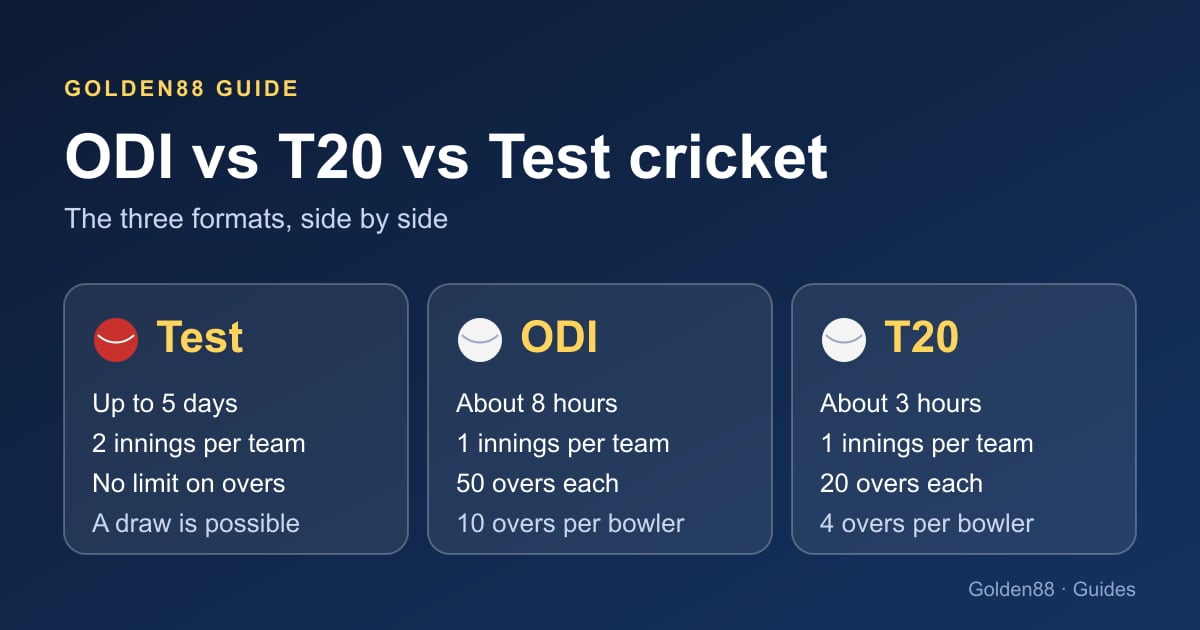
The three formats at a glance
These are the standard rules for men's international matches. Leagues and women's matches can differ in details.
| Feature | Test | ODI | T20 |
|---|---|---|---|
| Length | Up to 5 days | About 7 to 8 hours (one day) | About 3 hours |
| Innings per team | 2 | 1 | 1 |
| Overs per innings | No limit | 50 | 20 |
| Overs per bowler | No limit | 10 | 4 |
| Ball and kit | Red ball (pink in day-night matches), white clothing | White ball, coloured team kit | White ball, coloured team kit |
| Possible results | Win, draw or (very rarely) tie | Win, tie or no result | Win, tie or no result |
Test cricket
Test cricket is the oldest and longest format. A Test is scheduled for up to five days, with a minimum of 90 overs a day, although weather and slow bowling can reduce that. Each team bats twice unless one side wins before it has to.
To win a Test a team must score more runs over both of its innings and bowl the other team out twice. If time runs out before that happens, the match is a draw. A captain can declare an innings closed to leave enough time to bowl the opponents out. If a team finishes its first innings a long way behind (200 runs or more in a five-day Test), the other captain may ask it to bat again straight away, which is called enforcing the follow-on.
One-day internationals (ODI)
In an ODI each team bats once for up to 50 overs, and a bowler may bowl at most ten of them. The innings is divided into three phases with fielding restrictions: under the current ICC rules for men's ODIs, two fielders may be outside the 30-yard circle in overs 1 to 10, four in overs 11 to 40, and five in overs 41 to 50. A match lasts about seven to eight hours with a break between innings.
Twenty20 (T20)
T20 is the shortest of the three: 20 overs per team, four overs per bowler, and a powerplay of six overs with only two fielders outside the circle. Batters take more risks, so scores move quickly. Our T20 rules guide explains overs, powerplays, the super over and rain rules in detail.
Newer and shorter formats
- T10: ten overs per side, played in about 90 minutes.
- The Hundred: 100 balls per side, bowled in sets of five or ten balls.
- Women's Test matches are scheduled for four days instead of five.
How the result is written
A win "by an innings" means one team scored more runs in a single innings than the other team scored in both of its innings together.
- Test: "won by an innings and 50 runs", "won by 7 wickets" or "match drawn".
- ODI and T20, team batting first wins: "won by 25 runs".
- ODI and T20, team batting second wins: "won by 4 wickets" (the number of wickets it still had in hand).
Frequently asked questions
- Why are Test matches so long? Because there is no limit on overs and both teams must be bowled out twice, a Test tests stamina and technique as well as scoring.
- Can a Test match be a tie? Yes, if the scores are level when the team batting last is all out, but it is extremely rare. Far more Tests end in a win or a draw.
- Which format should a new fan start with? T20 is the quickest to follow because a match is short and has a result almost every time. ODIs and Tests reward patience.
Where these rules come from
The formats follow the Laws of Cricket, kept by the MCC, and the ICC playing conditions for international matches. Competitions publish their own regulations and the rules are revised from time to time, so check the rules of the series you are following.