
T20 cricket rules explained: a beginner's guide
Twenty20 (T20) is the shortest major format of cricket: each team bats once, for a maximum of 20 overs, and a match takes about three hours. This guide explains the rules a new fan needs to follow a T20 game.
What is T20 cricket?
T20 was first played in England in 2003 and is now played all over the world, from national teams in the T20 World Cup to leagues such as the IPL and the BPL.
- Two teams of 11 players.
- One innings (one turn to bat) per team, of up to 20 overs.
- The team that scores more runs wins.
- A whole match takes roughly three hours.
How overs and wickets work
An over is six legal deliveries (balls) bowled by the same bowler. After every over the ball is bowled from the other end by a different bowler. In T20 a bowler can bowl at most four overs in an innings, so a team needs at least five bowlers to complete its 20 overs.
A batting team has ten wickets. An innings ends when 20 overs have been bowled, when ten batters are out (the team is "all out"), or when the team batting second has scored enough runs to win. The main ways a batter can be out are:
- Bowled: the ball hits the stumps.
- Caught: a fielder catches the ball before it touches the ground after the batter hit it.
- LBW (leg before wicket): the ball hits the batter's body or pad and would otherwise have gone on to hit the stumps. There are exceptions, for example depending on where the ball pitched.
- Run out: the fielding side breaks the stumps while a batter running between the wickets is short of the crease.
- Stumped: the wicketkeeper breaks the stumps while the batter is out of their crease after missing the ball.
Runs, boundaries and extras
Batters score by running between the wickets, or by hitting the ball to the boundary: a four if it reaches the rope after touching the ground, and a six if it crosses the rope without bouncing.
Extras are runs that do not come off the bat. A wide (a ball too far from the batter to hit) and a no-ball (an illegal delivery, for example when the bowler's front foot is over the line) each give the batting team a run and must be bowled again, so they do not count as one of the six balls. In international T20 cricket the delivery after a no-ball is a free hit: the batter cannot be out in most ways, but can still be run out. Byes and leg byes are runs scored when the ball goes past the batter without touching the bat.
What is a powerplay?
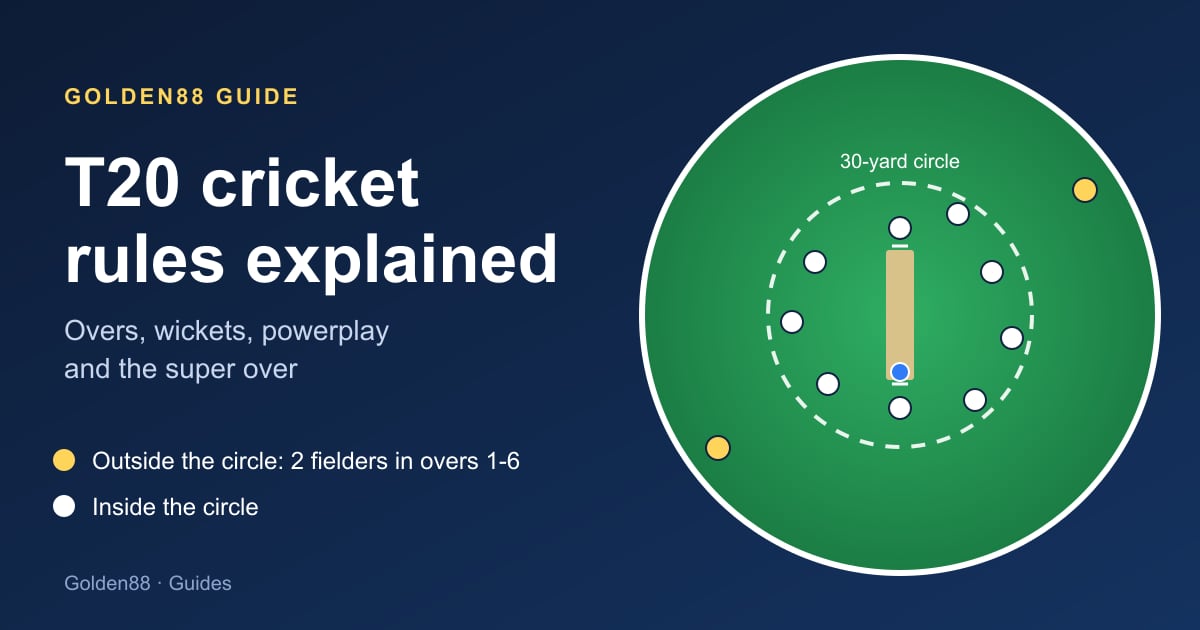
The first six overs of each innings are the powerplay. Fielding restrictions apply: only two fielders may stand outside the 30-yard circle, the dashed ring marked around the pitch. From the seventh over to the twentieth, up to five fielders may stand outside the circle.
The restrictions make it easier to hit boundaries, so teams often score fast in the powerplay, and bowlers who take wickets early can change the whole match.
How a result is decided
The team that scores more runs wins. The team batting first sets a target. If the team batting second passes it, they win at once, and the margin is given in wickets left: if the first team scored 160 and the second team reaches 161 for the loss of four wickets, they win "by six wickets". If the second team falls short, the first team wins "by" the number of runs between the scores. If both teams score the same, the match is tied.
What is a super over?
In many competitions a tied T20 match is decided by a super over: each team plays one extra over of six balls. The team that batted second in the match bats first in the super over, and a team's super-over innings ends after six balls or when it loses two wickets. The team with more runs wins. Competitions word the details differently, for example what happens if the super over is also tied, so check the rules of the tournament you are watching.
Rain and the DLS method
When rain shortens a match, most competitions use the Duckworth-Lewis-Stern (DLS) method to set a revised target for the team batting second, based on the overs and wickets they have available. A minimum number of overs per side must be played for a result; for T20 matches this is often five overs per side. If that is not possible, the match ends with no result.
Frequently asked questions
- How long does a T20 match last? Usually about three to three and a half hours, with a short break between the two innings.
- Can a T20 match end in a draw? No. A match ends with a win, a tie (which many competitions settle with a super over) or, if the weather stops play, no result.
- What is the difference between a T20 and a T20I? A T20 International (T20I) is a match between two national teams. Leagues such as the IPL are T20 matches between clubs or franchises.
- Do all T20 competitions use the same rules? The basic rules are the same, but each competition can add its own, such as extra substitutes, time limits or tie-break details.
Where these rules come from
The explanations follow the Laws of Cricket, which are kept by the MCC, and the playing conditions published by the ICC for international matches. Competitions add their own regulations, and rules are updated from time to time, so always check the rules of the match you are following.